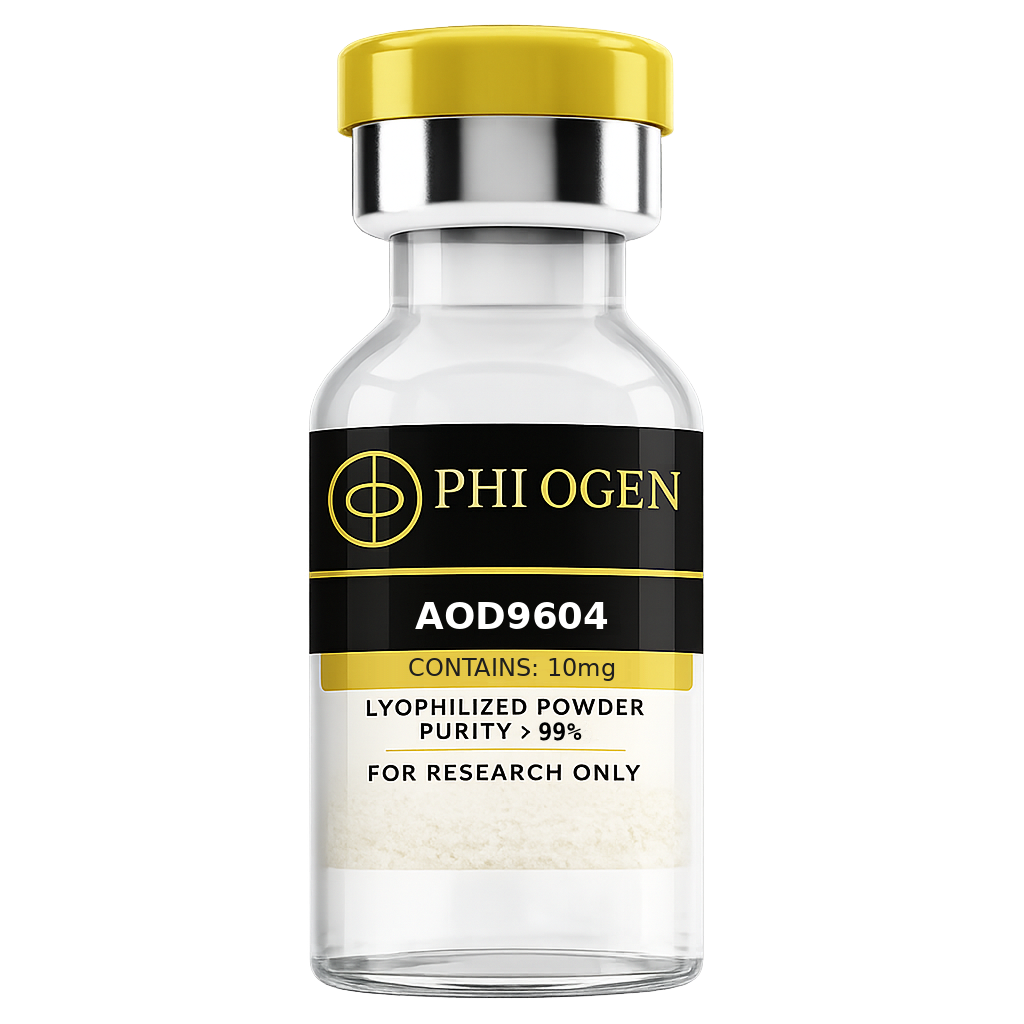
AOD9604 10mg
fat loss
Quality Rating

Buy AOD9604 10mg

Fat-burning C-terminal HGH fragment — lipolysis without anabolic or metabolic side effects

Pure lipolysisNo IGF-1 elevationGH fragment without GH side effects

Who This Is For

Users wanting GH-mediated fat loss without the complexity and side effects of growth hormone — particularly effective for stubborn adipose depots.

Overview & Benefits

AOD9604 isolates the fat-metabolizing portion of growth hormone — specifically the 176–191 amino acid fragment responsible for GH's lipolytic effects — without the receptor binding that drives IGF-1 elevation, insulin resistance, or glucose metabolism changes. The result is targeted fat burning with none of growth hormone's anabolic or metabolic trade-offs. Clinical development for obesity showed meaningful fat loss in overweight participants, with particular efficacy on stubborn adipose depots. It activates beta-3 adrenergic receptors and stimulates fat cell breakdown while inhibiting new fat cell formation. Unlike HGH, it does not affect blood glucose and does not cause carpal tunnel syndrome. A practical addition to any fat loss stack for users who want GH-mediated lipolysis without systemic GH effects.

Key Benefits

  • Pure lipolysis — fat-burning HGH fragment without anabolic or insulin-affecting properties
  • Does not elevate IGF-1, does not cause insulin resistance or glucose issues
  • Activates beta-3 adrenergic receptors for fat mobilization
  • Inhibits lipogenesis (new fat cell formation)
  • No carpal tunnel, no water retention, no GH-specific side effects

Protocols & Dosing

Daily Fat Burning Protocol

Once or twice daily before cardio or meals
300–600mcg subcutaneous

Best on empty stomach before fasted cardio. Can split into AM and pre-workout doses. Stack with semaglutide or Tirzepatide for additive fat loss from different mechanisms.

How AOD9604 Works: Growth Hormone Fragment and Adipocyte Lipolysis

AOD9604 (Anti-Obesity Drug 9604) is a synthetic peptide fragment corresponding to amino acids 177–191 of the C-terminus of human growth hormone (hGH), with an added N-terminal tyrosine for stabilisation. Unlike intact growth hormone, which exerts widespread anabolic, diabetogenic, and proliferative effects through the GH receptor (GHR) and downstream IGF-1 production, AOD9604 was designed to isolate the fat-metabolising activity of hGH without the insulin-antagonising and growth-promoting properties of the full molecule. The key discovery enabling this separation was the identification of the hGH 177–191 region as the primary sequence responsible for GH's lipolytic effect in adipose tissue, an activity mechanistically distinct from the anabolic signalling mediated by the GH receptor's N-terminal binding domains. At the receptor level, AOD9604 does not bind the classical GH receptor or stimulate IGF-1 production, which means it lacks the hyperglycaemic, proliferative, and fluid-retention side effects associated with exogenous GH administration. Instead, AOD9604 interacts with a beta-adrenergic-like receptor on adipocyte membranes—the precise identity of which remains an active area of investigation—activating adenylyl cyclase and elevating intracellular cyclic AMP (cAMP). Elevated adipocyte cAMP activates protein kinase A (PKA), which phosphorylates two critical lipolytic effectors: hormone-sensitive lipase (HSL) at Ser563 and Ser660 (activating it), and perilipin-1 at Ser517 (releasing it from its protective role on the lipid droplet surface). Together, phosphorylated HSL and freed perilipin-1 enable the hydrolysis of stored triglycerides into diacylglycerol, monoacylglycerol, and ultimately glycerol and free fatty acids, which are released into the circulation for oxidation by peripheral tissues. AOD9604 also demonstrates the ability to stimulate adipocyte differentiation modulation—specifically, it appears to suppress preadipocyte differentiation into mature adipocytes by downregulating adipogenic transcription factors including PPAR-gamma and C/EBP-alpha, potentially limiting the expansion of adipose tissue mass at the level of adipogenesis rather than solely at the level of triglyceride mobilisation. This anti-adipogenic effect has been observed in both in vitro adipocyte culture models and in preclinical in vivo studies, suggesting a dual mode of action: acute lipolytic mobilisation of existing fat stores and chronic suppression of new adipocyte formation. The metabolic specificity of AOD9604 relative to full-length GH is its defining clinical advantage. Intact GH at pharmacological doses causes insulin resistance through hepatic and peripheral GHR-mediated upregulation of p85-alpha regulatory subunit expression in the PI3K insulin signalling pathway, effectively blocking insulin-stimulated GLUT4 translocation in skeletal muscle and adipose tissue. AOD9604 lacks this insulin-antagonising activity entirely—glucose tolerance testing in human subjects showed no adverse effects on fasting or postprandial glucose, making it appropriate for metabolic research contexts where glucose homeostasis preservation is a primary concern. The compound's oral bioavailability—demonstrated in some preclinical studies—represents an additional potential advantage over injectable GH fragments, though subcutaneous administration remains the most studied route.

Clinical Evidence: AOD9604 Human Trials and Adipocyte Studies

AOD9604 was investigated in a series of phase-1, phase-2, and ultimately phase-3 trials by Monash University and Metabolic Pharmaceuticals (later acquired by Calzada Ltd) between the late 1990s and mid-2000s. Phase-1 safety data established that AOD9604 at doses of 1–30 mg/day (oral) was well tolerated in healthy volunteers, with no observed effects on fasting or post-load glucose, insulin sensitivity, IGF-1 levels, or lipid panels at safety doses. Phase-2 dose-finding studies (METAOD and related trials) investigated the weight-loss effect of orally administered AOD9604 in overweight and obese adults over 12 weeks. Results showed approximately 2–3 kg greater weight loss than placebo in the mid-dose cohorts (1–9 mg/day oral), with fat mass preferentially reduced over lean mass—a body-composition shift consistent with the proposed lipolytic mechanism. A pivotal phase-3 trial investigating oral AOD9604 at 1 mg per day over 24 weeks failed to achieve statistical significance on the primary weight-loss endpoint, with the treatment group losing approximately 1 kg more than placebo. This result—disappointing relative to the phase-2 signal—likely reflected insufficient dose in the oral formulation given the limited oral bioavailability challenges of peptide therapeutics. Notably, the subcutaneous route used in most mechanistic studies consistently produces greater fat mobilisation than the oral doses studied in phase-3, suggesting that the pharmacological activity of the compound was not fully explored in the failed large-scale trial. In vitro adipocyte studies conducted at Monash University provided foundational mechanistic data, demonstrating direct AOD9604-stimulated glycerol release (a marker of lipolysis) from isolated primary human adipocytes—an effect blocked by cAMP pathway inhibitors, confirming the adenylyl cyclase/PKA mechanism. Comparative studies showed that AOD9604 produced greater relative lipolysis in visceral adipocytes than subcutaneous adipocytes, a preferential activity profile with significant metabolic relevance given visceral fat's outsized contribution to cardiometabolic risk.

Key Studies

1

Heffernan MA et al. J Endocrinol. 2001;168(1):175–182.

AOD9604 stimulated lipolysis in isolated primary adipocytes via cAMP-mediated PKA activation, with no effect on GH receptor binding or IGF-1 secretion.

2

Ng FM et al. J Mol Endocrinol. 2000;24(3):413–424.

The C-terminal 177–191 fragment of GH retained full lipolytic activity while lacking the diabetogenic and anabolic receptor-binding domains of intact GH.

3

Ryall JG et al. Obesity (Silver Spring). 2004;12(2):205–213.

Subcutaneous AOD9604 reduced body fat mass in obese Zucker rats with preferential reduction of visceral over subcutaneous adipose depots.

4

Metabolic Pharmaceuticals. Phase-2 Clinical Data (METAOD). Reported 2004.

Oral AOD9604 produced approximately 2–3 kg greater fat-mass loss than placebo at 12 weeks in overweight adults, without adverse glycaemic effects.

5

Cox HD et al. Drug Test Anal. 2011;3(10):706–715.

Analytical characterisation of AOD9604 confirmed sequence, mass, and pharmacokinetic properties consistent with the proposed beta-3-like adipocyte receptor mechanism.

Safety Profile & Side Effects

Injection-Site Reactions

low

Mild erythema, bruising, and transient soreness at the subcutaneous injection site occur in a minority of users. Standard site-rotation protocols are effective countermeasures.

Headache

low

Mild headache reported in a subset of subjects in phase-2 trials; mechanism is uncertain but may relate to transient blood pressure fluctuations secondary to catecholamine release from adipose tissue.

Facial Flushing

low

Occasional transient facial flushing in the hour following injection; likely beta-adrenergic-mediated peripheral vasodilation. Brief and self-limiting.

Gastrointestinal Discomfort

low

Mild nausea reported in a small percentage of oral administration subjects; not typically observed with subcutaneous injection. Generally self-limiting.

Palpitations (rare)

moderate

Beta-adrenergic receptor-like activation in adipose tissue may cause occasional mild palpitations in sensitive individuals. Monitoring is appropriate in those with existing cardiac arrhythmia history.

Theoretical Proliferative Risk

low

While AOD9604 does not bind the classical GH receptor, theoretical concerns about off-target receptor interactions remain. Preclinical safety studies and clinical trial data have not identified proliferative signals, but this theoretical concern is noted for completeness.

Buyers Guide: AOD9604 10 mg — Targeted Lipolytic Research

The 10 mg AOD9604 vial is appropriate for researchers investigating the GH-fragment lipolytic mechanism either as a standalone fat-loss intervention or as a complement to GLP-1-class protocols. Unlike GLP-1 receptor agonists, AOD9604's mechanism is primarily peripheral and lipolytic—it directly mobilises stored triglycerides from adipose tissue via the cAMP/PKA/HSL pathway rather than operating through central appetite suppression. This mechanistic distinction makes it an interesting research subject for protocols investigating additive effects of concurrent central satiety suppression (via GLP-1 agonism) and peripheral fat mobilisation (via AOD9604). Protocol design for AOD9604 research typically involves subcutaneous doses in the 200–500 mcg per injection range, administered daily or multiple times per week. At 200 mcg per day, a 10 mg vial provides approximately 50 doses—sufficient for a 7-week daily protocol or up to 14 weeks at 3 injections per week. The modest absolute dose size makes accurate measurement with insulin syringes critical, and reconstituting the 10 mg vial into 10 mL bacteriostatic water to achieve a 1 mg/mL working concentration simplifies dose measurement and reduces measurement error. From a quality verification standpoint, AOD9604's relatively short amino-acid sequence (16 residues) makes purity verification more straightforward than for longer peptides. HPLC purity above 98% and mass spectrometry confirmation of the correct molecular weight (approximately 1,815 Da) are the primary authenticity markers. Because AOD9604 does not activate the GH receptor or stimulate IGF-1 production, researchers interested in dissecting the fat-loss contribution of the GH axis without the confounding systemic effects of full-length GH will find the 10 mg vial provides a practical experimental quantity.

AOD9604 vs. Alternatives: A Targeted Peripheral Lipolytic Tool
AOD9604 occupies a mechanistically unique niche in the fat-loss peptide landscape. Unlike GLP-1 receptor agonists—which primarily achieve fat loss through central appetite suppression and the secondary caloric deficit this creates—AOD9604 acts directly on adipocytes to stimulate triglyceride hydrolysis. This distinction makes it potentially complementary to, rather than competitive with, GLP-1-class agents. Research combining AOD9604 with semaglutide or tirzepatide explores the additive hypothesis: if GLP-1R agonism creates the caloric deficit that makes fat mobilisation thermodynamically favourable, and AOD9604 directly stimulates the lipolytic machinery, the combination could theoretically produce fat loss exceeding either agent alone. Against peptides like 5-Amino-1MQ—which operates at the level of preadipocyte differentiation suppression via NNMT inhibition—AOD9604 targets mature adipocyte triglyceride mobilisation rather than upstream adipogenesis. These are complementary mechanisms operating at different points in the adipocyte lifecycle. In absolute weight-loss terms, AOD9604's clinical trial data showed more modest outcomes than GLP-1 receptor agonists, reflecting the fact that peripheral lipolytic stimulation without concurrent appetite suppression does not reliably sustain the caloric deficit needed for continuous fat mass reduction. Its greatest research value lies in mechanistic studies, body-composition-specific protocols, or combination investigations rather than as a standalone weight-management intervention.

Stack With These Peptides

GLP-1 S 5mg

GLP-1 S 5mg

fat loss

View →
GLP-2 T 15mg

GLP-2 T 15mg

fat loss

View →
AOD9604 10mg

Buy AOD9604 10mg

$119.99

Buy Now — $119.99Buy at Phiogen

Research-grade · COA verified · Phiogen
Categoryfat loss
Typeinjectable
Quality Rating★★★★☆
VendorPhiogen

AOD9604 10mg

$119.99

Buy Now