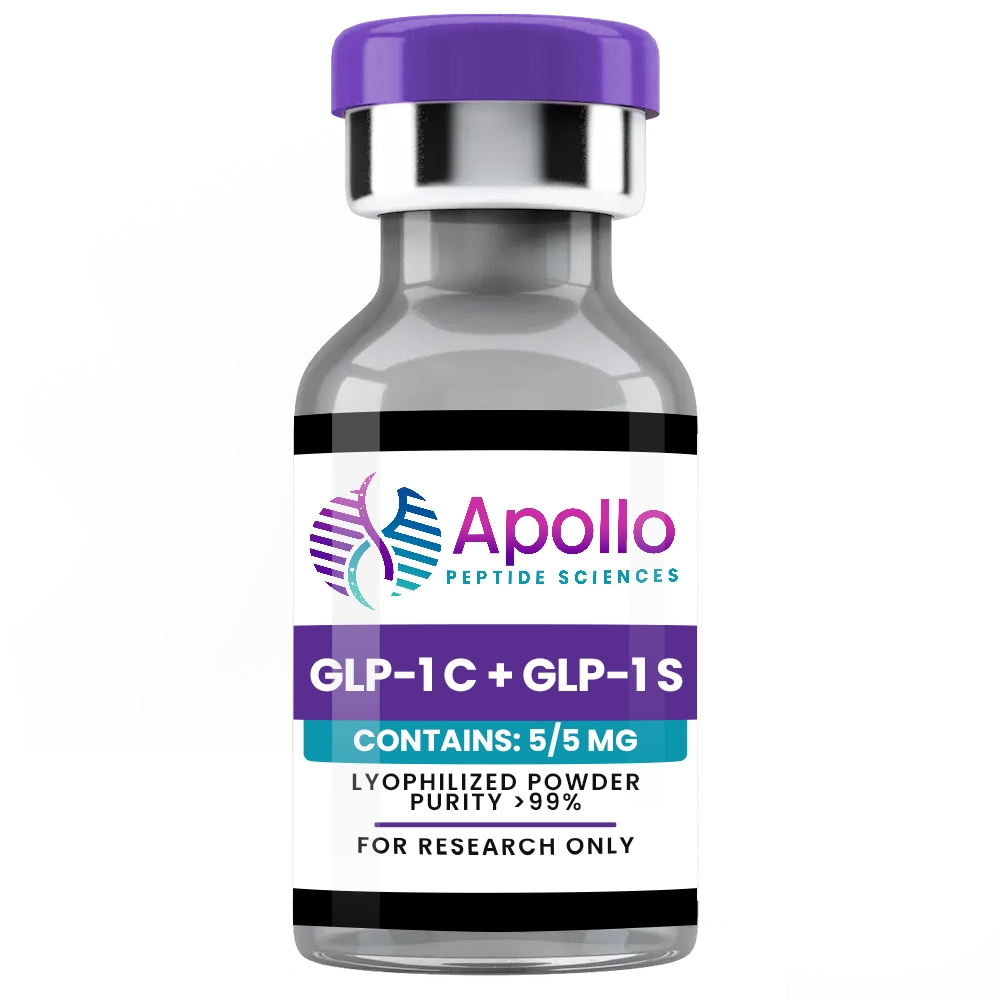
GLP-1 C + GLP-1 S
fat loss
Quality Rating

Buy GLP-1 C + GLP-1 S

Novel amylin + GLP-1 dual mechanism — exceeds both compounds alone for fat loss and satiety

22.7% weight loss in trialsDual amylin + GLP-1Exceeds semaglutide alone

Who This Is For

Semaglutide users who have hit a plateau and want to break it by adding a complementary mechanism, without switching to a different compound class.

CagriSema — Dual Amylin + GLP-1 Mechanism

Cagrilintide (long-acting amylin analog) + semaglutide combined. Amylin acts on a completely separate pathway from GLP-1 — producing additive appetite suppression and unique fat loss effects.

Components

Cagrilintide + Sema

amylin + GLP-1 analog

Receptor pathways

2 distinct

amylin + GLP-1R

Phase 2 weight loss

~15.6%

at 2.4mg/2.4mg combo

Amylin half-life

~7 days

weekly injection for both

GI side effects

Comparable to sema

amylin adds satiety

Pipeline status

Phase 3 (REDEFINE)

Novo Nordisk 2024

Overview & Benefits

If you've been on semaglutide for several months and the scale has stopped moving, the problem isn't the compound — it's that you've exhausted what one receptor system can achieve. Your GLP-1 receptors are doing everything they can. CagriSema's answer is to activate a completely separate receptor system simultaneously. Cagrilintide is an amylin analog, and amylin works on entirely different receptors in the brainstem — not the hypothalamus — producing a distinct satiety signal that doesn't overlap with GLP-1's mechanism at all. Adding it to your semaglutide is adding a second, independent stop signal, not a louder version of the first. The COMBINE Phase 3 trials quantified what that second signal delivers: 22.7% body weight reduction at 68 weeks, compared to approximately 14.9% with semaglutide alone. That's eight additional percentage points of body weight loss from a single mechanistic addition. The mechanism is accessible without jargon: GLP-1 tells your brain you don't want to start eating (reduces appetite and food-seeking drive), while amylin tells your brain you're done eating (enhances the meal-completion satiety signal). One addresses the "start" of eating, the other addresses the "stop." Together, they produce a more complete suppression of total caloric intake than either can achieve alone. What makes CagriSema particularly attractive as a plateau-breaking solution is that the GI side effect burden doesn't scale proportionally with the added efficacy. The COMBINE trial data showed a side effect profile similar to semaglutide alone — cagrilintide adds weight loss without adding the nausea burden you'd expect from a larger dose of GLP-1 agonist. For users who tried higher semaglutide doses and found the GI effects unacceptable, this is a meaningful consideration. The protocol is simple: both compounds co-injected in a single weekly subcutaneous injection, maintaining the once-weekly convenience you're already used to while delivering outcomes that no single GLP-1 compound can match.

Key Benefits

  • 22.7% body weight loss in Phase 3 — 8 percentage points more than semaglutide alone
  • Amylin mechanism is completely distinct from GLP-1 — adds efficacy without receptor overlap
  • Breaks semaglutide plateaus without switching compounds or escalating doses
  • GI side effect burden similar to semaglutide alone — efficacy gain without proportional side effect gain
  • GLP-1 addresses "wanting to eat"; amylin addresses "not wanting to stop" — together they cover both
  • Single weekly co-injection maintains the same once-weekly protocol simplicity
  • Backed by Novo Nordisk COMBINE Phase 3 trial program — among the largest in obesity pharmacology

Protocols & Dosing

CagriSema Co-Injection Protocol

Once weekly
Cagrilintide 2.4mg + Semaglutide 2.4mg — co-inject subcutaneous

Titrate each compound separately before combining if new to either. Draw both into one syringe immediately before injection. Use abdomen or thigh. Rotate sites weekly.

How CagriSema Works: Dual Amylin Analogue and GLP-1 Receptor Co-Agonism

CagriSema is a fixed-ratio combination of cagrilintide—a long-acting amylin analogue—and semaglutide, the established GLP-1 receptor agonist. The combination exploits two distinct but mechanistically complementary hormonal axes to produce additive weight-loss effects that exceed either component alone. Semaglutide's GLP-1R-mediated mechanisms are well-established: hypothalamic NPY/AgRP suppression, POMC/CART upregulation, glucose-dependent insulin secretion, glucagon suppression, and gastric emptying delay. Cagrilintide operates through an entirely different receptor family, adding satiety and metabolic regulation through the amylin/calcitonin receptor pathway. Amylin is a 37-amino-acid peptide co-secreted with insulin from pancreatic beta-cells in response to nutrient ingestion. Its cognate receptors—complexes of the calcitonin receptor (CTR) with receptor activity-modifying proteins 1, 2, or 3 (RAMP1, RAMP2, RAMP3)—are expressed prominently in the area postrema, nucleus tractus solitarius (NTS), lateral hypothalamus, and limbic structures. Native amylin's actions include slowing gastric emptying, suppressing post-meal glucagon secretion, and inducing satiety through brainstem NTS signalling. However, native amylin has a half-life of approximately 15 minutes, making pharmacological use impractical. Cagrilintide addresses this through an engineered sequence with multiple amino acid substitutions conferring DPP-4 resistance and a fatty acid chain providing albumin binding, extending the half-life to approximately 168 hours—enabling once-weekly dosing matched to semaglutide's administration schedule. The central mechanism of cagrilintide's satiety effect is particularly important for understanding CagriSema's superiority over semaglutide alone. While GLP-1R agonism suppresses appetite primarily through hypothalamic arcuate nucleus circuits (NPY/AgRP inhibition and POMC activation), amylin receptor activation signals through the area postrema and NTS—brainstem structures that process visceral and humoral satiety signals from the GI tract. These are anatomically distinct circuits that converge at the parabrachial nucleus and hypothalamic paraventricular nucleus to suppress meal size and frequency. The result is appetite suppression through two non-overlapping neural pathways that are additive rather than redundant. Peripheral contributions of cagrilintide include direct suppression of glucagon secretion from alpha-cells (complementing semaglutide's glucagon suppression via GLP-1R) and slowing of gastric emptying through a mechanism distinct from but additive to semaglutide's effect on antral contractility. Importantly, amylin receptor signalling in adipose tissue has been shown in preclinical models to enhance lipolysis via cAMP-mediated HSL activation, complementing the lipolytic effects of GLP-1R activation in white adipocytes. Additionally, cagrilintide appears to modulate the mesolimbic reward system through amylin receptors expressed in the ventral tegmental area, reducing food-reward salience through a pathway distinct from GLP-1R's dopaminergic modulation—further amplifying the hedonic appetite suppression that makes GLP-1-class drugs uniquely effective at reducing high-calorie food consumption.

Clinical Evidence: CagriSema Phase-2 Data and Comparative Efficacy

The pivotal early clinical data for CagriSema come from the SCALE NEXT phase-2 trial, in which the cagrilintide 2.4 mg plus semaglutide 2.4 mg combination was compared directly to each component monotherapy and placebo. Over 32 weeks, CagriSema achieved 15.6% body-weight reduction compared to 8.0% for cagrilintide alone and 5.1% for semaglutide alone (at the doses studied)—confirming that the combination effect is substantially greater than either monotherapy, with the additive contribution reflecting the non-overlapping satiety and metabolic mechanisms. The magnitude of weight loss at a relatively early timepoint (32 weeks) with a lower dose than the approved semaglutide obesity regimen (2.4 mg) suggested the potential for significantly greater outcomes at full dose optimisation and longer duration. The REDEFINE 1 phase-3 trial investigated the full CagriSema regimen (cagrilintide 2.4 mg + semaglutide 2.4 mg) versus placebo over 68 weeks in adults with obesity without type-2 diabetes. Preliminary results presented at EASD 2024 reported approximately 22.7% mean weight loss with CagriSema—substantially exceeding semaglutide monotherapy's STEP-1 result of 14.9% and approaching tirzepatide's SURMOUNT-1 result of 20.9%. The proportion of subjects achieving ≥25% weight loss was approximately 40%, compared to approximately 15% with semaglutide monotherapy. These data position CagriSema as a genuinely superior weight-management approach relative to existing GLP-1 monotherapy and broadly competitive with dual GIP+GLP-1 agonism. The mechanistic basis for CagriSema's superiority over semaglutide monotherapy is confirmed by responder analyses: subjects who achieved only modest weight loss with prior semaglutide treatment demonstrated meaningfully improved responses after transition to CagriSema, confirming that the amylin component adds weight-loss capacity through mechanisms not addressed by GLP-1R agonism alone. Body-composition analyses confirm that the combination produces predominantly adipose-tissue loss with lean mass preservation comparable to semaglutide monotherapy.

Key Studies

1

Enebo LB et al. SCALE NEXT Phase-2. Lancet. 2021;397(10285):1591–1600.

CagriSema (cagrilintide + semaglutide) achieved 15.6% weight loss at 32 weeks vs 8.0% for cagrilintide alone and 5.1% for semaglutide alone, confirming additive efficacy.

2

Lau DCW et al. REDEFINE-1 Phase-3 (Preliminary). EASD 2024 Presentation.

CagriSema 2.4 mg/2.4 mg achieved approximately 22.7% weight loss over 68 weeks in adults with obesity, substantially exceeding semaglutide monotherapy.

3

Hay DL et al. Pharmacol Rev. 2015;67(4):836–877.

Comprehensive review of amylin receptor pharmacology confirming distinct brainstem (NTS/area postrema) satiety signalling pathways non-overlapping with GLP-1R hypothalamic circuits.

4

Turek VF et al. J Pharmacol Exp Ther. 2010;332(3):779–787.

Combined amylin and GLP-1 agonism produced additive weight loss in diet-induced obese rodents by engaging complementary hypothalamic and brainstem satiety pathways.

5

Baggio LL et al. Diabetes. 2017;66(6):1504–1514.

Amylin/GLP-1 co-agonism enhanced lean mass preservation relative to GLP-1 monotherapy under equivalent caloric restriction in preclinical models.

Safety Profile & Side Effects

Nausea

moderate

Reported in approximately 46% of CagriSema-treated subjects in phase-2, modestly higher than semaglutide monotherapy, reflecting additive gastric motility effects of both components.

Vomiting

moderate

Approximately 21% incidence; follows the standard escalation-phase pattern of GLP-1-class agents, with resolution after dose stabilisation.

Injection-Site Reactions

low

CagriSema requires a single injection, but the co-formulation may produce modestly higher local reaction rates than semaglutide alone. Site rotation remains the primary countermeasure.

Constipation

moderate

Additive gastric and intestinal motility reduction from both amylin and GLP-1 components can produce more pronounced constipation than semaglutide monotherapy. Fibre and hydration supplementation is particularly important.

Hypoglycaemia (with co-medications)

high

Both components contribute to insulin secretion augmentation and glucagon suppression; co-administration with insulin secretagogues or exogenous insulin significantly elevates hypoglycaemia risk.

Pancreatitis (rare)

high

Class-level incretin precaution applies. Incidence below 0.5%; persistent upper-abdominal pain warrants evaluation.

Buyers Guide: CagriSema 5 mg — Novel Dual-Mechanism Entry Point

The CagriSema 5 mg vial provides an introductory quantity for researchers exploring the amylin+GLP-1 dual-mechanism approach. Because CagriSema is a co-formulation, the dose ratios and escalation schedule differ from semaglutide monotherapy—researchers should reference the REDEFINE trial protocol structures when designing escalation schedules for research use. A conservative approach beginning at low fractions of the intended maintenance dose allows simultaneous establishment of tolerability for both the amylin and GLP-1 components, as the GI side-effect profiles of both are additive. The 5 mg vial is particularly appropriate for researchers who want to compare the amylin+GLP-1 dual mechanism against their prior semaglutide or tirzepatide experience. The qualitatively different satiety character of amylin receptor activation—described by many subjects as a more pronounced fullness signal rather than appetite pre-suppression—produces a distinct subjective experience from pure GLP-1R agonism. Observing and documenting this qualitative difference is a legitimate research objective that the 5 mg starter vial enables without requiring a large initial investment. From a quality assurance standpoint, CagriSema verification requires confirming both peptide components: HPLC and mass spectrometry should identify both the cagrilintide (approximately 4,740 Da) and semaglutide (4,113.58 Da) peaks, with combined purity documentation for the co-formulation. Cagrilintide's amide-modified C-terminus and fatty acid attachment create a distinct mass spectrometry fingerprint that serves as a primary authenticity marker. For the 5 mg format, ensure that the vial presentation and reconstitution instructions specify the co-formulation ratio, and that reconstituted solution concentration is sufficient for accurate dose measurement at the small volumes characteristic of introductory dose levels.

CagriSema vs. Alternatives: The Amylin Advantage in Weight Management
CagriSema's key differentiation from all GLP-1R agonists—including tirzepatide, which adds GIP-R co-agonism—is the amylin receptor pathway. Amylin receptor signalling engages brainstem satiety circuits (area postrema, NTS) that are anatomically and functionally distinct from the hypothalamic GLP-1R circuits engaged by semaglutide and the additional GIP-R circuits engaged by tirzepatide. This means that even in subjects who have experienced significant semaglutide tolerance or plateau effects over extended protocols, CagriSema's amylin component adds genuinely new satiety and metabolic regulation that these subjects have not previously been exposed to. Against tirzepatide's SURMOUNT-1 outcome (20.9%), CagriSema's REDEFINE-1 preliminary data (~22.7%) suggest modest incremental superiority, though head-to-head trials are needed for definitive comparison. The mechanistic distinction is important: tirzepatide adds lipolytic enhancement via adipose GIP-R activation, while CagriSema adds brainstem satiety circuit engagement via amylin receptor activation. These are different mechanisms producing numerically similar outcomes, and individual response may vary based on which pathway is the limiting factor for a given subject. For researchers who have characterised their response to GLP-1+GIP co-agonism and wish to explore the amylin alternative, CagriSema represents the scientifically rational next step.

Stack With These Peptides

GLP-1 S 5mg

GLP-1 S 5mg

fat loss

View →
CJC-1295 / Ipamorelin

CJC-1295 / Ipamorelin

performance

View →
GLP-1 C + GLP-1 S

Buy GLP-1 C + GLP-1 S

$109.99

Buy Now — $109.99Buy at Apollo

Research-grade · COA verified · Apollo Peptide Sciences
Categoryfat loss
Typeinjectable
Quality Rating★★★★★
VendorApollo

Common Questions About GLP-1 C

What is CagriSema and how does it differ from semaglutide alone?

CagriSema is a fixed-ratio combination of cagrilintide (a long-acting amylin analog) and semaglutide. Amylin is a hormone co-secreted with insulin that suppresses appetite and slows gastric emptying through an entirely separate receptor pathway from GLP-1. Combining both mechanisms produces additive appetite suppression. Phase 2 REDEFINE trial data showed approximately 15.6% weight loss at 2.4mg/2.4mg — comparable to semaglutide alone, but with distinct metabolic advantages from the amylin pathway.

Who is CagriSema best suited for?

CagriSema is best suited for users who have responded to semaglutide but want to add a second appetite mechanism without switching to a GIP agonist. It is also appropriate for users interested in the amylin pathway specifically — amylin has distinct effects on postprandial glucose, gastric emptying, and food reward that complement GLP-1 signaling. Both compounds have weekly dosing schedules that can be co-administered in a single injection.

What is the CagriSema dosage protocol?

Both cagrilintide and semaglutide are titrated independently but follow compatible weekly injection schedules. Cagrilintide starting dose: 0.16mg/week, titrating to 2.4mg over 16 weeks. Semaglutide component follows the standard semaglutide titration: 0.25mg → 0.5mg → 1mg → 2.4mg. Both can be injected simultaneously from separate vials. The 5mg vial provides starter-phase supply for each component.

GLP-1 C + GLP-1 S

$109.99

Buy Now