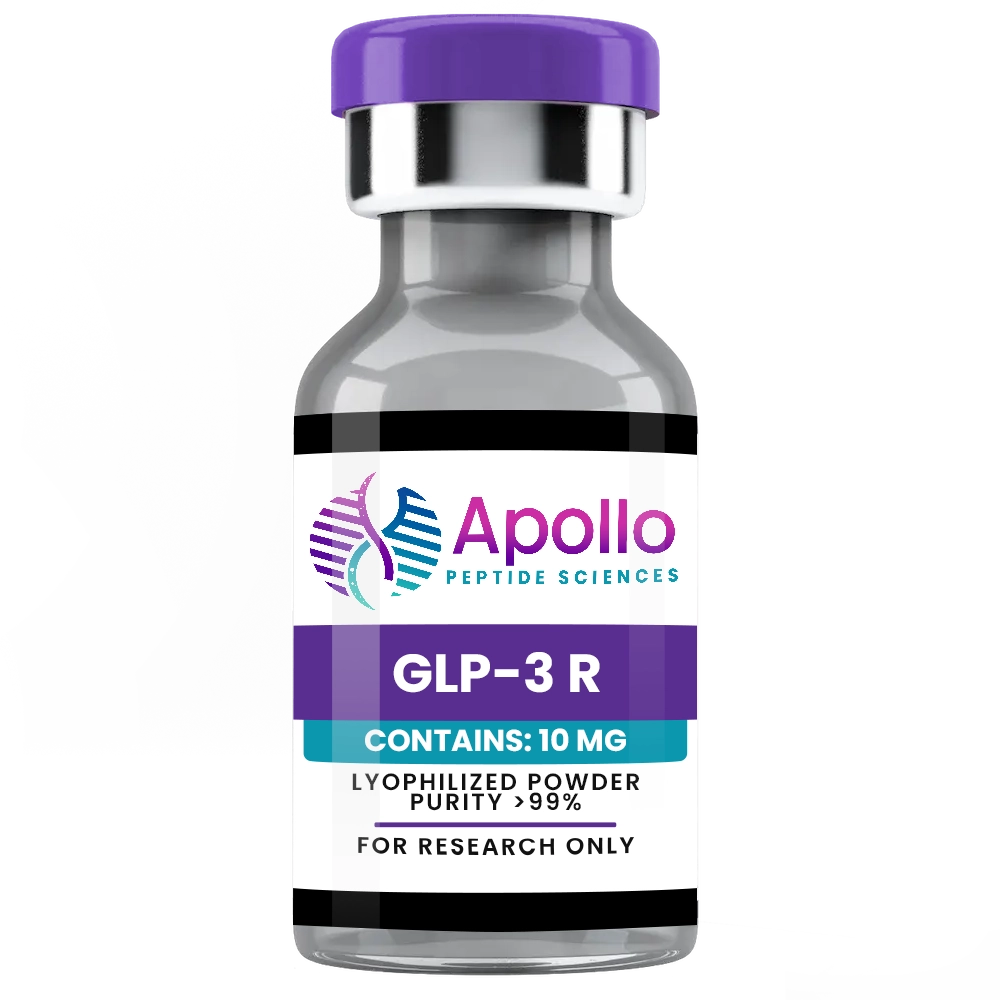
GLP-3 R 10mg
fat loss
Quality Rating

Buy GLP-3 R 10mg

Triple GLP-1 + GIP + glucagon agonist — the most potent fat loss peptide in clinical development

24.2% weight loss in trialsTriple GLP-1/GIP/GlucagonMost potent GLP class

Who This Is For

Users seeking maximum fat loss efficacy, those who have plateaued on semaglutide or tirzepatide, or anyone with significant metabolic obesity who wants the most potent GLP-class option available.

Retatrutide 10mg — Triple Agonist Entry

Triple GIP/GLP-1/glucagon receptor agonist — the most potent fat loss peptide available, adding glucagon-driven energy expenditure to dual agonism.

Receptor targets

GIP + GLP-1 + GCGR

triple agonism

Proven weight loss

24.2%

at 12mg dose, 48 wks

Energy expenditure

Elevated

glucagon receptor action

Titration start

1mg/week

slowest titration required

Supply at 1mg/wk

10 weeks

full titration phase

Development

Phase 2 complete

most advanced triple agonist

Overview & Benefits

Semaglutide reduces appetite. Tirzepatide reduces appetite and enhances fat oxidation. Retatrutide does both of those — and adds a third mechanism that neither can replicate: thermogenesis. By activating glucagon receptors alongside GLP-1 and GIP, retatrutide dramatically increases the rate at which your body generates heat by burning fat, particularly through brown adipose tissue activation and hepatic fat oxidation. The practical result was 24.2% mean body weight loss in 48 weeks of Phase 2 trials — the largest fat loss outcome ever recorded in a clinical peptide study at that timepoint. This is the compound for people who have tried semaglutide or tirzepatide and hit a ceiling, or for those starting from a position where the marginal advantage of triple-agonist signaling is worth the step up in management complexity. The glucagon component is what makes retatrutide categorically different, not just incrementally better. While appetite suppression creates a caloric deficit and GIP enhances fat oxidation, glucagon receptor activation increases basal energy expenditure — your body burns more calories at rest. This combination of "eat less, absorb less fat, burn more" is a three-pronged metabolic intervention with no equivalent. The thermogenic advantage comes with a trade-off that demands attention: elevated glucagon signaling can promote muscle protein catabolism if protein intake is inadequate. This isn't unique to retatrutide — it's a known glucagon biology effect — but it's more pronounced than with tirzepatide. Users on retatrutide maintain minimum 1.8g protein per kilogram of lean body mass and frequently pair with CJC-1295/Ipamorelin to provide an anabolic counterforce. This combination represents the highest-efficacy body recomposition approach available. The 10mg vial covers your titration phase: starting at 1mg/week and stepping up carefully over 8–12 weeks to your maintenance dose. Slower titration than tirzepatide is recommended — the triple mechanism produces more pronounced initial GI effects, and patience in this phase pays dividends in long-term tolerability.

Key Benefits

  • 24.2% mean body weight loss in Phase 2 — the highest fat loss outcome in clinical peptide data
  • Thermogenic advantage: glucagon receptor activation increases basal energy expenditure beyond appetite suppression
  • Brown adipose tissue activation burns fat at rest — a mechanism semaglutide and tirzepatide lack entirely
  • Addresses metabolic syndrome comprehensively: appetite, fat oxidation, energy expenditure, and liver health simultaneously
  • Significant NASH and liver fat reduction driven by the glucagon component
  • The logical next step for users who have plateaued on tirzepatide
  • Pairs with CJC-1295/Ipamorelin to counterbalance glucagon-driven catabolism for body recomposition

Protocols & Dosing

Beginner Retatrutide Titration

Once weekly injection
Weeks 1–4: 1mg | Weeks 5–8: 2mg | Weeks 9–12: 4mg | Maintenance: 4–8mg

Slower titration than tirzepatide recommended due to triple mechanism. GI side effects can be more pronounced. Anti-nausea support recommended for first 4–6 weeks.

How Retatrutide Works: Triple GLP-1, GIP, and Glucagon Receptor Agonism

Retatrutide (LY3437943) is a single synthetic peptide that simultaneously activates three distinct receptors: the glucagon-like peptide-1 receptor (GLP-1R), the glucose-dependent insulinotropic polypeptide receptor (GIP-R), and the glucagon receptor (GCGR). This triple co-agonism represents the leading edge of incretin pharmacology and produces a mechanistically additive weight-loss effect that exceeds any dual or single-receptor agonist developed to date. The molecule is 45 amino acids in length, derived from a glucagon backbone, with engineered amino acid substitutions conferring GLP-1R and GIP-R binding while preserving native glucagon receptor interaction. A fatty acid chain attached via a gamma-glutamic acid linker provides albumin binding sufficient for once-weekly administration. GLP-1R activation by retatrutide follows the well-established pathway: hypothalamic appetite suppression via NPY/AgRP inhibition and POMC/CART upregulation, glucose-dependent insulin secretion from pancreatic beta-cells, glucagon suppression, and gastric motility reduction. GIP-R co-agonism adds adipose-tissue lipolytic enhancement (particularly under caloric restriction), brown adipose tissue UCP1 upregulation and thermogenesis amplification, and central satiety signal reinforcement—the same additive mechanisms responsible for tirzepatide's superiority over pure GLP-1 agents. The defining third element—glucagon receptor agonism—introduces mechanisms entirely absent from GLP-1 and GIP-class agents. GCGR activation stimulates hepatic glucose production from glycogen and amino acids (glycogenolysis and gluconeogenesis), which in isolation would be counterproductive in metabolic management. However, in the context of simultaneous GLP-1R and GIP-R agonism, the resulting hyperglucagonaemia is held in check, and the net hepatic metabolic effect shifts toward enhanced fat oxidation (beta-oxidation of long-chain fatty acids) and thermogenesis. Hepatic GCGR activation powerfully increases hepatic fatty acid oxidation via PKA/CREB-mediated upregulation of CPT1 (carnitine palmitoyltransferase 1) and suppression of ACC (acetyl-CoA carboxylase), diverting hepatic lipid away from storage toward combustion. Brown adipose tissue GCGR expression enables glucagon to directly stimulate BAT thermogenesis via cAMP-mediated UCP1 induction, an effect amplified by simultaneous GIP-R activation. The aggregate thermogenic contribution to retatrutide's efficacy—estimated at an additional 80–150 kcal/day above basal metabolic rate in preclinical models—represents a meaningful passive energy-expenditure increment that neither tirzepatide nor semaglutide provides. Additionally, GCGR agonism promotes satiety through central nervous system pathways independent of GLP-1R and GIP-R, including direct hypothalamic GCGR-mediated orexigenic neuron suppression. These complementary mechanisms collectively explain why retatrutide's phase-2 weight-loss data exceeded all prior pharmacological benchmarks.

Clinical Evidence: Retatrutide Phase-2 Data and Mechanistic Studies

The primary published clinical dataset for retatrutide is the phase-2 dose-finding trial by Jastreboff et al. (2023), which enrolled 338 adults with obesity (BMI ≥30 or ≥27 with comorbidities) and randomised them to placebo or retatrutide at doses ranging from 1 mg to 12 mg weekly for 48 weeks. The 12 mg cohort achieved a mean body-weight reduction of 24.2% from baseline—the highest ever reported in a placebo-controlled weight-management trial for a pharmacological agent. Remarkably, the weight-loss trajectory in the 12 mg group had not plateaued at 48 weeks, suggesting that the 24-week plateau commonly observed with GLP-1 monotherapy may be substantially delayed or eliminated by the triple-agonist mechanism. Approximately 26% of participants in the highest-dose cohort achieved ≥30% body-weight loss. Body-composition analyses in the phase-2 trial confirmed that the majority of weight lost was adipose mass. Visceral adipose tissue declined disproportionately, with MRI-measured reductions of approximately 40% in the 12 mg group. Hepatic fat fraction declined by approximately 60% from baseline in subjects with non-alcoholic fatty liver disease (NAFLD) at enrollment—a result that exceeds any pharmacological intervention previously studied in fatty liver disease. These hepatic effects are mechanistically attributable to the GCGR component, which directly upregulates hepatic fatty acid oxidation and suppresses de novo lipogenesis via CREB/PPAR-alpha pathways. Phase-3 TRIUMPH trials are ongoing as of early 2026. The phase-2 cardiovascular biomarker data are encouraging: subjects showed improvements in blood pressure, triglycerides, LDL-cholesterol, and CRP at least as large as those seen with tirzepatide, with the GCGR component potentially providing additional lipoprotein-modulating effects through VLDL secretion suppression. The totality of available evidence positions retatrutide as potentially the most potent weight-management pharmacotherapy ever developed, pending phase-3 confirmation.

Key Studies

1

Jastreboff AM et al. Retatrutide Phase-2 Trial. N Engl J Med. 2023;389(6):514–526.

Retatrutide 12 mg weekly achieved 24.2% mean weight loss at 48 weeks—the highest recorded in any placebo-controlled pharmacological obesity trial.

2

Coskun T et al. Mol Metab. 2022;57:101461.

Triple GLP-1/GIP/glucagon co-agonism produced synergistic reductions in body weight, hepatic fat, and plasma lipids in preclinical models, exceeding dual-agonist benchmarks.

3

Ambery P et al. Lancet. 2018;391(10140):2607–2618.

Dual GLP-1/glucagon agonism reduced body weight and hepatic fat in humans, establishing the basis for triple-agonist development.

4

Brandt SJ et al. Diabetes Obes Metab. 2018;20(9):2188–2200.

Glucagon receptor agonism specifically enhanced hepatic fat oxidation and brown adipose tissue thermogenesis in DIO mouse models.

5

Holst JJ, Rosenkilde MM. J Clin Endocrinol Metab. 2020;105(8):e2956–e2964.

Review confirming that simultaneous GLP-1R, GIP-R, and GCGR activation produces non-redundant, additive metabolic benefits attributable to distinct signalling pathways.

Safety Profile & Side Effects

Nausea and Vomiting

moderate

Reported in approximately 45% and 25% of subjects respectively in the phase-2 trial, proportionally higher than tirzepatide. The glucagon component may amplify gastric motility changes. Slow escalation substantially reduces incidence.

Diarrhoea

moderate

Present in approximately 20–25% of subjects. Similar mechanistic origin to other GLP-1R agonists. Dietary modifications during escalation mitigate severity.

Decreased Appetite (severe)

moderate

The triple-agonist satiety suppression can be more pronounced than with dual agonists. Structured dietary planning and caloric monitoring are important to prevent inadequate intake.

Heart Rate Elevation

moderate

Glucagon receptor agonism has positive chronotropic effects. Mean heart rate increases of 3–5 bpm were observed in the phase-2 trial; monitoring is warranted in subjects with cardiac history.

Injection-Site Reactions

low

Mild local reactions at injection sites occur in a small percentage of users. Standard rotation protocols minimise recurrence.

Pancreatitis (rare)

high

Class-level precaution applies across all incretin-based therapies. Persistent severe upper-abdominal pain requires evaluation.

Buyers Guide: Retatrutide 10 mg — Cautious Entry into Triple-Agonist Research

The 10 mg retatrutide vial is the entry point for researchers beginning their first triple-agonist protocol. Phase-2 trial escalation started at 1 mg weekly for the first four weeks, advancing by 1–2 mg increments every four weeks based on tolerability. A 10 mg vial provides sufficient supply for the entire introductory escalation phase (weeks 1–16 at doses of 1–4 mg weekly) while limiting financial commitment during the period of highest tolerability uncertainty. Given that retatrutide's phase-3 data were still maturing as of early 2026, researchers new to this compound benefit from the conservative inventory management that the 10 mg vial enables. The triple-agonist mechanism produces a qualitatively different appetite-suppression experience than semaglutide or tirzepatide—many subjects report not just reduced hunger but a notable reduction in food-reward salience that manifests earlier in the escalation schedule. This heightened efficacy at low doses means that some subjects will achieve meaningful fat-loss outcomes without ever reaching the maximal 12 mg dose used in the phase-2 trial. Researchers should track weekly body-composition metrics from the outset to identify response inflection points that guide dose optimisation. Given that retatrutide is a more complex 45-amino-acid peptide with multiple engineered modifications, quality verification is more demanding than for shorter peptides. Certificates of analysis should confirm HPLC purity above 98%, mass spectrometry verification of the intact peptide mass (~5,765 Da for retatrutide), residual solvent levels below ICH Q3C limits, and endotoxin content below 1 EU/mg. The 10 mg starter vial is the appropriate quantity to verify supplier quality before committing to larger purchases.

Retatrutide vs. Alternatives: The Triple-Agonist Frontier

Retatrutide occupies the leading edge of weight-management pharmacology, with phase-2 data showing approximately 24% mean weight loss—exceeding tirzepatide's 20.9% SURMOUNT-1 result and semaglutide's 14.9% STEP-1 result by meaningful margins. The glucagon receptor component is the differentiating mechanism: it adds hepatic fat oxidation, BAT thermogenesis, and a third satiety pathway that neither semaglutide nor tirzepatide engages. However, the interpretive confidence gap is substantial. Tirzepatide and semaglutide have extensive phase-3 data, cardiovascular outcome trials, and real-world safety records. Retatrutide's dataset consists primarily of phase-2 results and mechanistic studies. For researchers who prioritise efficacy maximisation over evidence maturity, retatrutide is the current leading candidate. For those who require phase-3 validation and safety characterisation before protocol initiation, tirzepatide remains the highest-efficacy well-characterised option. The 10 mg starter vial serves the former group with appropriate caution.

Stack With These Peptides

CJC-1295 / Ipamorelin

CJC-1295 / Ipamorelin

performance

View →
GLP-3 R 10mg

Buy GLP-3 R 10mg

$149.99

Buy Now — $149.99Buy at Apollo

Research-grade · COA verified · Apollo Peptide Sciences
Categoryfat loss
Typeinjectable
Quality Rating★★★★★
VendorApollo

Common Questions About GLP-3 R

What makes retatrutide different from semaglutide and tirzepatide?

Retatrutide is a triple agonist — it activates GLP-1, GIP, and glucagon receptors simultaneously. The glucagon component adds thermogenesis (increases basal metabolic rate by an estimated 5–8%), which single and dual agonists lack. Phase 2 trial data showed up to 24% body weight reduction — the highest clinical result in the GLP-1 class at that time. It remains in Phase 3 development (Eli Lilly) and is not yet an approved pharmaceutical.

What is the retatrutide dosage protocol?

Starting dose: 0.5–1mg/week subcutaneous injection. Titrate by 1mg every 4 weeks as tolerated: 1mg → 2mg → 4mg → 6mg → 8mg → 12mg (Phase 2 maximum). Most users find the optimal efficacy-to-tolerability balance at 4–8mg/week. The glucagon component makes GI side effects more pronounced than tirzepatide at comparable doses — meticulous titration is non-negotiable. The 10mg vial at 2mg/week provides 5 weeks — primarily covering the early titration phase.

Retatrutide vs tirzepatide — which is more effective?

Phase 2 data places retatrutide above tirzepatide in raw weight loss percentage — approximately 24% vs 22.5%. The glucagon receptor component adds thermogenesis (increased caloric expenditure) on top of the shared GLP-1/GIP appetite and satiety mechanisms. However, retatrutide carries higher GI side effect burden at therapeutic doses and requires more meticulous titration. It is the advanced option for experienced users who have maximized tirzepatide results and are seeking further fat loss.

GLP-3 R 10mg

$149.99

Buy Now