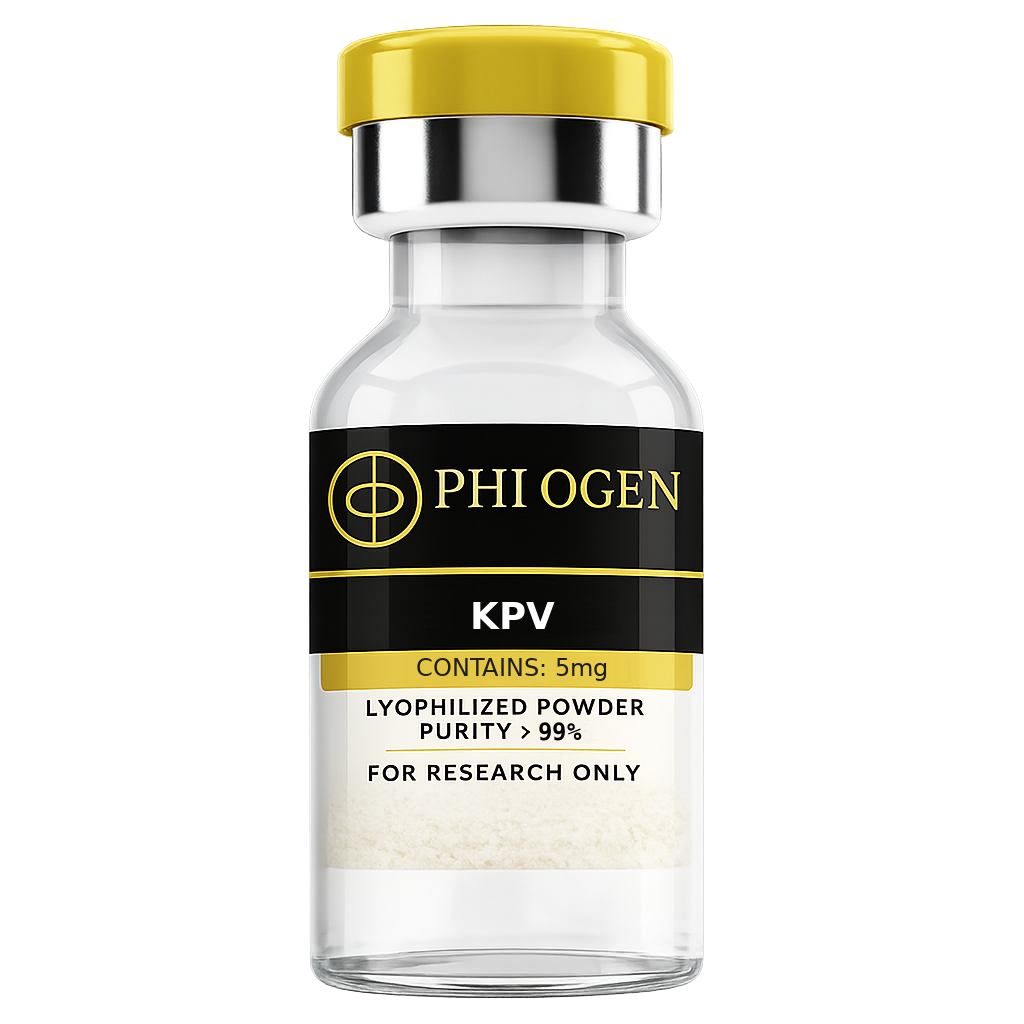
KPV 5mg
healing
Quality Rating

Buy KPV 5mg

Entry KPV supply for mucosal anti-inflammation protocols

Entry supplyGut anti-inflammationMucosal healing

Who This Is For

First-time KPV users testing gut anti-inflammatory response.

Overview & Benefits

The 5mg vial provides 4–8 weeks of supply at 250–500mcg/day — ideal for testing KPV's anti-inflammatory effects before committing to the 10mg vial.

Key Benefits

  • Entry supply for KPV protocols
  • Same mucosal anti-inflammatory mechanism
  • 4–8 week supply at standard doses

Protocols & Dosing

Entry Protocol

Twice daily
250mcg oral or subcutaneous

Assess gut inflammation response before upgrading to 10mg.

How KPV Resolves Inflammation Through Melanocortin Receptor Agonism

KPV (Lys-Pro-Val) is a C-terminal tripeptide fragment of alpha-melanocyte-stimulating hormone (α-MSH), encompassing the terminal three amino acids of this 13-residue peptide. Despite its small size, KPV retains the core anti-inflammatory bioactivity of the full α-MSH molecule by acting as an agonist at melanocortin receptors, particularly MC1R and MC3R, which are expressed on immune cells, epithelial cells, enterocytes, and neurons throughout the body. Melanocortin receptor activation triggers a well-characterised intracellular signalling cascade: Gαs-coupled cAMP elevation, followed by PKA activation, which in turn phosphorylates CREB and activates NF-κB inhibitory mechanisms. The net result is a profound downregulation of pro-inflammatory transcription. The NF-κB suppression mediated by KPV is the mechanistic centrepiece of its anti-inflammatory activity. NF-κB is the master transcription factor for acute inflammatory gene expression; its targets include TNF-α, IL-1β, IL-6, IL-8, iNOS, COX-2, and a suite of adhesion molecules (ICAM-1, VCAM-1) responsible for leukocyte recruitment to inflamed tissue. By blocking IκB kinase (IKK) phosphorylation and stabilising the inhibitory IκBα protein, KPV prevents NF-κB nuclear translocation and effectively turns off the inflammatory gene expression programme. This mechanism is shared with glucocorticoids but achieved without binding to the glucocorticoid receptor, meaning KPV's anti-inflammatory effects come without the HPA axis suppression, immunosuppression, or metabolic side effects associated with steroid use. A particularly important feature of KPV biology is its effectiveness at mucosal surfaces. KPV is resistant to luminal proteolysis to a degree unusual for a tripeptide, and its small size facilitates paracellular and transcellular uptake by intestinal epithelium. Once internalised, it acts directly on enterocytes and subepithelial immune cells to reduce inflammatory cytokine production and improve tight junction integrity — the barrier function of the intestinal epithelium that is compromised in inflammatory bowel disease. Studies in colitis models demonstrate that oral KPV reduces mucosal cytokine levels, decreases crypt dropout, and preserves villous architecture more effectively than topical application alone, suggesting functional uptake from the gut lumen. KPV also demonstrates modulatory effects on mast cell degranulation. By activating MC1R on mast cells, it raises the threshold for IgE-mediated and complement-triggered degranulation, reducing histamine and prostaglandin release without ablating the mast cell response entirely. This makes KPV of particular research interest in allergic and atopic models alongside its better-characterised IBD and systemic inflammation applications. Additionally, KPV crosses the blood-brain barrier and reduces neuroinflammation via MC1R/MC3R expressed on microglia, suggesting potential CNS applications that remain an emerging area of preclinical investigation.

Research Evidence & Clinical Data for KPV

The evidence base for KPV is primarily centred on gastrointestinal inflammation, particularly experimental colitis models. The seminal work by Kannengiesser and colleagues using KPV-loaded nanoparticles in DSS (dextran sulphate sodium)-induced colitis in mice demonstrated dramatic reductions in macroscopic and histological disease scores, with mucosal cytokine profiles normalising toward control levels. These findings have been independently replicated and extended to TNBS-induced colitis models, providing cross-validation across two distinct mechanistic models of colonic inflammation. The oral route of administration was found to be effective — a significant finding because it implies the peptide survives transit to inflamed colonic mucosa in sufficient quantities to exert local effects. Systemic anti-inflammatory effects have been demonstrated in models of endotoxemia and carrageenan-induced paw oedema. In these models, KPV reduces plasma IL-6 and TNF-α levels and decreases tissue swelling comparably to indomethacin (an NSAID) without the gastrointestinal toxicity. Wound healing data shows KPV accelerates re-epithelialisation in excisional wound models, consistent with the known role of MC1R activation in keratinocyte migration. These findings position KPV as a multi-context anti-inflammatory agent rather than a purely gut-targeted compound. Human data for KPV specifically is very limited. The mechanistic rationale is strongly supported, and the parent molecule α-MSH has been tested in Phase I/II settings for inflammatory conditions with encouraging safety data, but KPV as an isolated tripeptide has not been through controlled clinical trials. Some translational extrapolation from α-MSH clinical data is scientifically justified given the shared receptor mechanism, but should be treated cautiously. The emerging interest in nanoparticle delivery systems for KPV — which significantly improve bioavailability and targeting to inflamed mucosa — represents the most promising direction for clinical translation and is an active area of pharmaceutical development.

Key Studies

1

Kannengiesser K et al., Biomaterials (2008)

Nanoparticle-encapsulated KPV delivered orally dramatically reduced DSS-induced colitis severity in mice, decreasing histological damage scores, reducing mucosal IL-6 and TNF-α, and improving tight junction protein expression.

2

Brzoska T et al., Journal of Investigative Dermatology (2008)

Demonstrated that α-MSH-derived peptides including KPV accelerate wound closure in murine excisional wound models through MC1R-mediated keratinocyte migration, with anti-inflammatory reduction of wound bed cytokines.

3

Catania A et al., Peptides (2000)

Confirmed that KPV mimics full-length α-MSH in suppressing NF-κB activation and reducing TNF-α production in activated macrophages, with comparable potency per molar concentration despite the much smaller molecular size.

4

Labbe S et al., International Journal of Molecular Sciences (2021)

Review of melanocortin peptide mechanisms in IBD, documenting KPV's preservation of intestinal barrier function and reduction of epithelial permeability alongside its cytokine-suppressing effects in colitis models.

5

Sandvik AK et al., Alimentary Pharmacology & Therapeutics (1997)

Early demonstration that α-MSH and its C-terminal fragments including KPV reduce gastric acid secretion and mucosal inflammation in animal models of gastritis, establishing the GI mucosal targeting of this peptide class.

Safety Profile & Side Effects

Mild Hyperpigmentation

low

KPV retains some melanocortin receptor agonism that may stimulate melanocytes at higher systemic concentrations, potentially causing mild and usually reversible skin darkening. This is dose-dependent and has not been a significant concern in research models at standard doses.

Appetite and Metabolic Effects

low

Melanocortin receptors (particularly MC4R) play a key role in appetite regulation and energy homeostasis. At high doses, KPV and related α-MSH fragments can suppress appetite and alter metabolic rate. At doses used in anti-inflammatory research protocols, these effects are generally negligible.

Injection Site Irritation

low

Standard subcutaneous injection-associated reactions including transient redness, swelling, and discomfort are the most commonly reported adverse events. These are consistent with the general profile of injectable peptides and are managed through proper technique and site rotation.

Transient Nausea

low

Nausea has been reported with both oral and injectable KPV, particularly at higher doses. This may reflect the peptide's direct effects on GI motility and mucosal secretion, as GI tissue is one of its primary targets. Dose reduction typically resolves the issue.

Buyer's Guide: Selecting and Using KPV Tripeptide 5mg

KPV at 5mg vials is appropriate for research focused on inflammatory bowel disease models, mucosal wound healing, systemic anti-inflammatory interventions, and skin inflammatory conditions. The 5mg vial reflects the relatively low dosing requirements for this potent tripeptide; in rodent models, biologically active doses are typically in the range of 100–400 mcg/kg, making 5mg sufficient for multiple experimental animals at standard doses. Researchers investigating oral delivery models should note that nanoparticle encapsulation dramatically improves efficacy for colonic delivery; free peptide orally remains active but at lower overall bioavailability than encapsulated formulations. Quality assessment for KPV requires verification of the exact tripeptide sequence (Lys-Pro-Val, H-Lys-Pro-Val-OH) by mass spectrometry (MW 340.42 g/mol) and HPLC purity ≥98%. Because KPV is a very small peptide, impurity profiles are particularly important — synthesis of tripeptides can leave significant side-product contamination if purification is inadequate. A reputable supplier will provide a CoA showing the specific impurity profile, not merely overall purity. Lyophilised KPV is stable for extended periods at −20°C; reconstituted solution should be used within 3–4 weeks when refrigerated. Researchers can expect anti-inflammatory effects to manifest rapidly relative to structural repair peptides — in acute rodent inflammation models, significant cytokine reduction is evident within 24–72 hours of the first dose. For colitis models, measurable histological improvement typically requires 7–14 days of consistent dosing. KPV is well-suited to combination protocols with structural repair peptides (BPC-157, TB-500) where inflammatory control and tissue reconstruction are both desired, as its mechanism (MC1R/NF-κB) is non-overlapping with the VEGF, PI3K, and actin-based mechanisms of the other agents.

KPV vs. Other Anti-inflammatory and Healing Peptides

KPV's closest mechanistic comparator is BPC-157 in the anti-inflammatory domain, though their mechanisms are entirely distinct. BPC-157 reduces inflammation primarily through NO pathway modulation and cytoprotective mechanisms, while KPV operates via direct NF-κB suppression through melanocortin receptor agonism. KPV is generally considered the more potent targeted anti-inflammatory of the two — its cytokine-suppressing effects in inflamed tissue are more direct and rapid. However, BPC-157 adds structural repair mechanisms (angiogenesis, fibroblast activation, collagen synthesis) that KPV lacks. In acute injury models where both inflammation and structural damage are present, the combination is superior to either agent alone. Compared to systemic anti-inflammatories used in research contexts — such as dexamethasone or indomethacin — KPV provides a more targeted immunomodulatory profile with significantly fewer off-target effects. It lacks the HPA axis suppression, bone density effects, and metabolic complications of glucocorticoids, and the GI toxicity of NSAIDs. This safety advantage is particularly relevant for long-duration protocols. Against glutathione, KPV is the preferred choice where inflammatory cytokines are the primary target, while glutathione is more appropriate where oxidative stress and mitochondrial protection are the primary concerns. For IBD-specific research, KPV remains one of the most compelling experimental agents available and is increasingly the benchmark comparator against which novel therapeutic candidates are tested.

Stack With These Peptides

BPC-157 10mg

BPC-157 10mg

healing

View →
KPV 5mg

Buy KPV 5mg

$59.99

Buy Now — $59.99Buy at Phiogen

Research-grade · COA verified · Phiogen
Categoryhealing
Typeinjectable
Quality Rating★★★★☆
VendorPhiogen

KPV 5mg

$59.99

Buy Now