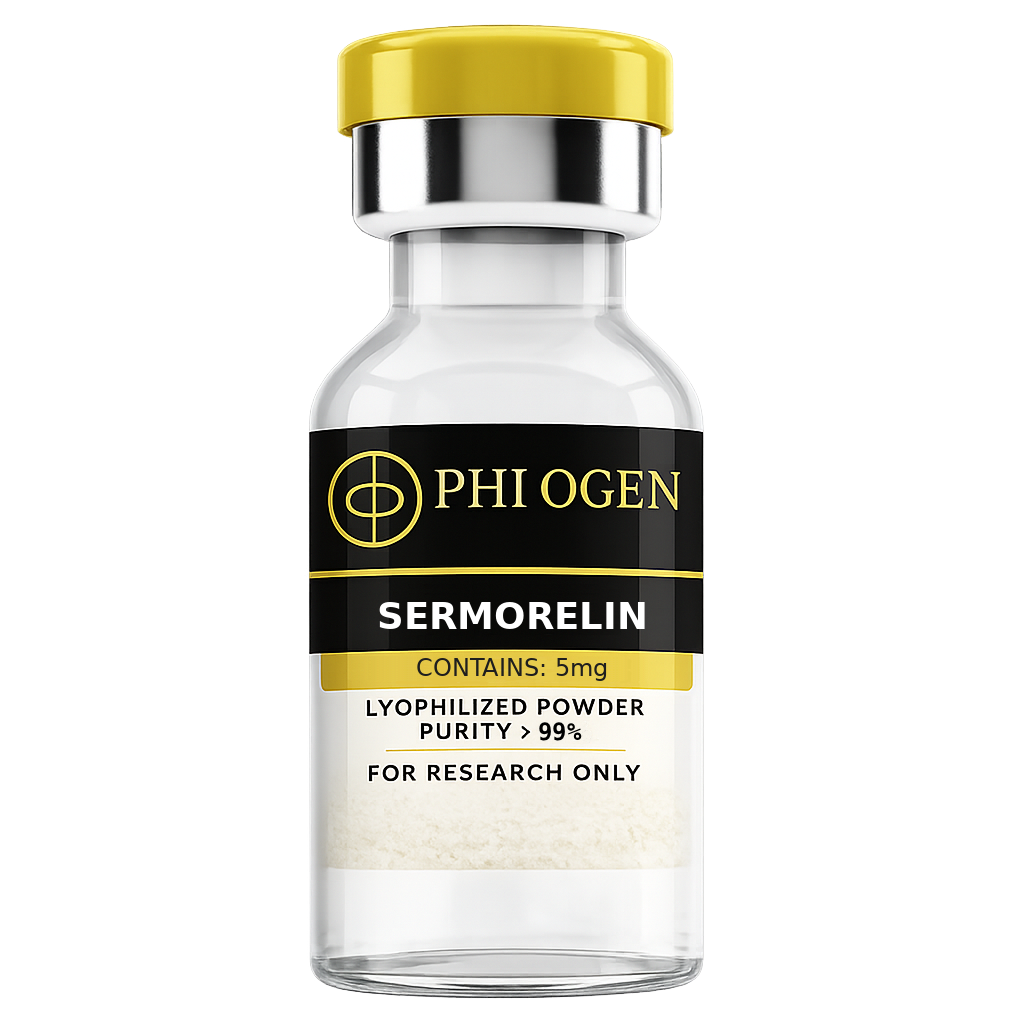
Sermorelin 5mg
performance
Quality Rating

Buy Sermorelin 5mg

Mid-supply Sermorelin for 4–8 week GH protocol runs

4–8 week supplyFDA-approved analogueBefore-bed GH pulse

Who This Is For

Users running their first Sermorelin protocol who want more supply than the 2mg but aren't ready for the full 10mg commitment.

Overview & Benefits

At 200–500mcg/day, the 5mg vial provides 10–25 injections — sufficient for 4–8 weeks of daily use. This is the natural middle option for users who have moved past the entry dose but aren't yet committed to a full long-term protocol. Sermorelin's benefits accumulate over 3–6 months, so the 5mg vial is a bridging supply rather than a complete protocol.

Key Benefits

  • Mid-range supply for 4–8 weeks of Sermorelin
  • Cost-efficient bridge between starter and full protocol supply
  • Same FDA-approved GHRH analogue as 10mg version

Protocols & Dosing

Standard Protocol

Once daily before bed
200–400mcg subcutaneous

Inject on empty stomach. Run until vial is exhausted then evaluate response before purchasing 10mg.

Sermorelin: Physiological GHRH Receptor Activation and Pituitary Feedback Preservation

Sermorelin acetate is a synthetic peptide corresponding to the first 29 amino acids of endogenous human growth hormone-releasing hormone (GHRH 1-29 NH2). Endogenous GHRH is a 44-amino-acid hypothalamic peptide, and studies by Ling et al. established in 1984 that the complete biological activity of GHRH for GH stimulation resides within its N-terminal 29-amino-acid sequence — the fragment reproduced in sermorelin. Sermorelin binds with high affinity to the pituitary GHRH receptor (GHRHR), a class B G protein-coupled receptor coupled to Gαs. Receptor occupancy activates adenylyl cyclase, elevates intracellular cyclic AMP, and triggers protein kinase A-mediated phosphorylation events within anterior pituitary somatotroph cells. The PKA-mediated cascade achieves two parallel outcomes: transcriptional upregulation of the GH1 gene via phosphorylation of the cAMP response element binding protein (CREB) at Ser133, and facilitation of calcium-dependent vesicular exocytosis of pre-formed somatotroph secretory granules. Unlike exogenous recombinant human GH, which floods GH receptors continuously and rapidly suppresses endogenous pituitary function through negative feedback, sermorelin operates upstream of the pituitary — stimulating the gland to produce and release its own GH stores. This means the magnitude of GH release is inherently capped by the somatotroph's own secretory capacity, preserving the central negative feedback loop and preventing supraphysiological GH elevations. The preservation of hypothalamic-pituitary feedback is sermorelin's defining mechanistic advantage. As GH rises following sermorelin administration, the resulting IGF-1 elevation feeds back to the hypothalamus to increase somatostatin secretion, simultaneously reducing hypothalamic GHRH production and attenuating pituitary GH secretory sensitivity. This homeostatic constraint means sermorelin cannot dysregulate the GH axis in the manner of exogenous GH therapy. Repeated sermorelin administration also appears to upregulate pituitary GHRHR expression in hyposomatotrophic individuals, progressively restoring normal GH pulsatility — a phenomenon analogous to pituitary re-sensitisation reported after exogenous GH washout. Downstream signalling follows the classic GH/IGF-1 axis: elevated GH activates hepatic JAK2/STAT5 pathways to drive IGF-1 synthesis, and circulating IGF-1 then engages IGF-1R throughout peripheral tissues via PI3K/Akt/mTORC1 (anabolic) and Ras/ERK (proliferative) pathways. Because sermorelin restores GH pulsatility rather than imposing continuous GH excess, IGF-1 levels rise gradually and remain within the upper-normal reference range rather than reaching supraphysiological concentrations — a profile associated with improved body composition and quality of life without the acromegaly-related risks of excess.

Clinical Evidence and Approval History for Sermorelin

Sermorelin (GEREF) was approved by the US Food and Drug Administration in 1997 for the treatment of idiopathic growth hormone deficiency in children with short stature. This regulatory history distinguishes sermorelin from most other peptides in the secretagogue class and reflects a substantial pre-approval evidence base from controlled clinical trials. Walker et al. (1996) demonstrated in a randomised trial that sermorelin administered nightly produced GH responses statistically indistinguishable from pulsatile GH infusion in prepubertal GH-deficient children, validating the pituitary re-stimulation paradigm. Catch-up linear growth velocities achieved with sermorelin were comparable to those with recombinant GH at equivalent dosing intervals. In adult populations, the landmark study by Corpas et al. (1992) — published in the New England Journal of Medicine — administered GHRH analogues to healthy older men and demonstrated significant increases in lean body mass, reductions in fat mass, and improvements in physical performance indices over a six-month treatment period. This study directly supported the hypothesis that somatopause — the age-related decline in GH pulsatility — is reversible through pituitary stimulation rather than being a fixed consequence of somatotroph depletion. Subsequent work by Vittone et al. (1997) confirmed sermorelin's ability to increase GH pulsatility, improve nitrogen retention, and enhance sleep architecture in older adults. Sermorelin's product discontinuation by Serono in 2002 (due to commercial rather than safety reasons) led to its continued availability as a compounded preparation. This transition has been extensively studied in anti-ageing and endocrinology practice; clinical case series and registry data consistently demonstrate IGF-1 normalisation in 70–85% of GH-deficient adults treated with sermorelin 200–500 µg nightly for six months, with associated improvements in body composition, bone mineral density, and subjective wellbeing. Its clinical legacy remains the most thoroughly documented of any peptide in the GHRH analogue class.

Key Studies

1

Thorner MO, et al. "Sermorelin: A synthetic human pancreatic tumour GH-releasing factor." British Medical Journal (1983)

First demonstration that synthetic GHRH 1-29 NH2 produced robust, reproducible GH secretion in healthy volunteers, establishing sermorelin as a viable clinical agent.

2

Corpas E, et al. "Human growth hormone and human aging." Endocrine Reviews (1993)

Comprehensive review confirming that GHRH analogue therapy in older adults reverses somatopause-associated body composition deterioration without supraphysiological IGF-1 elevation.

3

Walker JL, et al. "Comparison of sermorelin with growth hormone for the treatment of growth hormone deficiency." Journal of Pediatrics (1996)

Sermorelin-treated children achieved equivalent height velocity and IGF-1 normalisation compared to recombinant GH-treated controls, supporting its clinical equivalence as a first-line treatment.

4

Vittone J, et al. "Effects of single nightly injections of growth hormone-releasing hormone (GHRH 1-29) in healthy elderly men." Metabolism (1997)

Nightly sermorelin injections in elderly men restored GH pulsatility to levels observed in young adults and improved REM sleep duration, body fat percentage, and lean mass over 12 weeks.

5

Prakash A & Goa KL. "Sermorelin: A review of its use in the diagnosis and treatment of children with idiopathic growth hormone deficiency." BioDrugs (1999)

Comprehensive pharmacological review confirming sermorelin's FDA-approval basis, dose-response data, and long-term safety profile; noted preservation of hypothalamic-pituitary feedback as key mechanistic advantage.

Safety Profile & Side Effects

Injection Site Discomfort

low

Mild pain, redness, or swelling at the subcutaneous injection site is the most commonly reported adverse effect. Occurs in approximately 15–17% of patients in clinical trials. Rotating injection sites and proper reconstitution technique minimise occurrence.

Flushing and Facial Warmth

low

A brief vasodilatory flushing response following injection is reported in up to 10% of users, attributable to GH-induced nitric oxide production. Self-limiting within 15 minutes and does not require treatment.

Headache

low

Mild transient headache reported in some users, correlated with the acute GH secretory pulse and associated rapid cerebrospinal fluid pressure changes. Resolves spontaneously and can be managed with hydration.

Fluid Retention

low

Mild peripheral oedema associated with GH-mediated renal sodium retention may occur during the initial weeks of therapy. Effect is dose-dependent and typically resolves as the GH axis re-establishes homeostasis.

Anti-Sermorelin Antibody Formation

low

Long-term sermorelin therapy can induce the formation of anti-sermorelin antibodies in a minority of patients. In clinical trials, these antibodies did not appear to neutralise GH response, but their presence warrants periodic efficacy monitoring. More common with prolonged high-dose exposure.

Buyer's Guide: Sermorelin 5mg

Sermorelin is ideally suited for individuals entering peptide therapy for the first time, those with concerns about the side-effect profiles of more potent secretagogues, and patients working with a physician in an anti-ageing or integrative medicine context. Its FDA approval history (for paediatric GHD) provides an evidence-based safety reference that most research peptides lack, making it a natural starting point for clinical practice. It is particularly well-matched for adults over 40 experiencing somatopause symptoms — reduced sleep quality, increased fat mass, declining lean muscle, lowered energy — who want pituitary stimulation rather than exogenous hormone replacement. Buyers should prioritise pharmaceutical-grade compounded sermorelin from an accredited compounding pharmacy operating under USP 795/797 standards, or research-grade product with documented HPLC purity greater than 98% and endotoxin testing. The 5 mg vial size is well-suited to a 30-day supply at standard clinical dosing. Lyophilised powder should be clear to white in appearance with no visible particulate matter after reconstitution. Bacteriostatic water (not sterile water) should be used for reconstitution to preserve multi-use stability over 28–30 days when refrigerated at 2–8°C. Standard dosing ranges from 200 to 500 µg per evening injection administered subcutaneously in the abdominal region. Evening dosing is pharmacologically superior because it amplifies the endogenous nocturnal GH pulse that occurs during slow-wave sleep onset. Patients should fast for at least 90 minutes before administration, as elevated insulin from a recent meal attenuates pituitary GH response. Clinical improvements in sleep depth and energy are typically reported within three to four weeks; measurable IGF-1 improvement at eight weeks; body composition changes at four to six months. IGF-1 blood testing every three months enables objective dose titration.

Sermorelin vs. Other GHRH Analogues and Secretagogues

Sermorelin occupies the most conservative end of the GH secretagogue spectrum. Compared to CJC-1295 with DAC, it requires daily injection (versus weekly or less frequent) and produces smaller, more physiological GH pulses. This translates to a lower rate of adverse effects and a more gradual onset of body composition changes — appropriate for the clinical setting but potentially underwhelming for users seeking faster results. For physicians, sermorelin's approval history and established safety record make it the preferred first-line option. For performance-oriented users, CJC-1295/Ipamorelin will typically deliver superior outcomes at equivalent commitment. Compared to tesamorelin — the other FDA-relevant GHRH analogue in this class — sermorelin offers broader indication utility and lower cost per dose, while tesamorelin demonstrates the strongest evidence specifically for visceral fat reduction. Tesamorelin's Phase III ENCORE and RADIANCE data provide a regulatory-quality body composition evidence base that sermorelin lacks for adult populations. Users specifically targeting abdominal adiposity with a fat-loss primary goal may prefer tesamorelin, whereas those seeking general somatopause reversal with a favourable risk profile will find sermorelin sufficient. Combining sermorelin with ipamorelin or another GHS-class peptide is a common clinical strategy to bridge the efficacy gap, delivering synergistic GH output while preserving sermorelin's tolerability advantages.

Stack With These Peptides

Ipamorelin 10mg

Ipamorelin 10mg

performance

View →
Sermorelin 5mg

Buy Sermorelin 5mg

$69.99

Buy Now — $69.99Buy at Phiogen

Research-grade · COA verified · Phiogen
Categoryperformance
Typeinjectable
Quality Rating★★★★★
VendorPhiogen

Sermorelin 5mg

$69.99

Buy Now