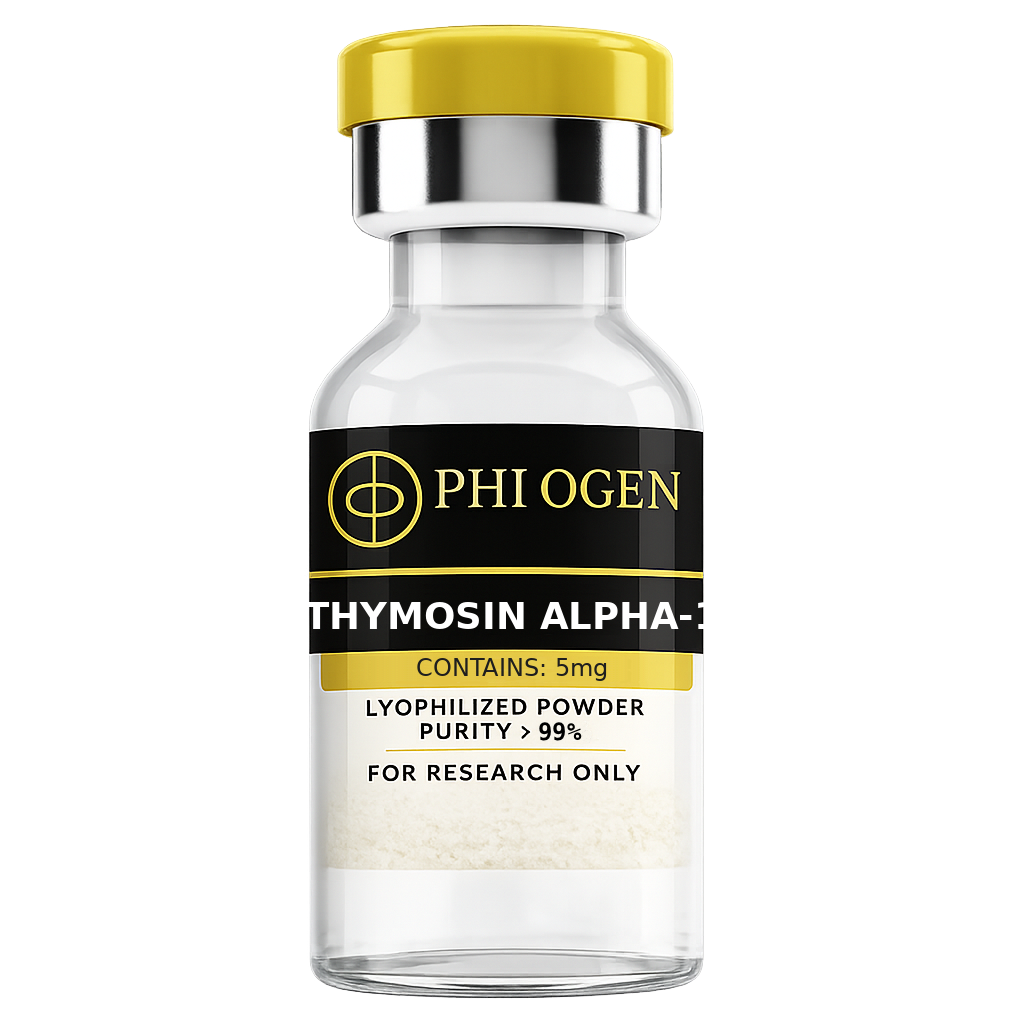
Thymosin Alpha-1 5mg
healing
Quality Rating

Buy Thymosin Alpha-1 5mg

Entry Thymosin Alpha-1 supply for immune modulation protocols

Entry supplyTwice-weekly protocolT-cell activation

Who This Is For

Users starting Thymosin Alpha-1 who want to test immune response at lower commitment.

Overview & Benefits

At 900mcg twice weekly, the 5mg vial provides approximately 5–6 doses — sufficient to assess initial immune modulation response before committing to the 10mg vial for a full protocol.

Key Benefits

  • Entry-level immune modulation supply
  • Same FDA-validated mechanism
  • 3–6 weeks at clinical twice-weekly doses

Protocols & Dosing

Entry Protocol

Twice weekly
900mcg subcutaneous

Assess immune markers after 3 weeks. Upgrade to 10mg for full protocol.

Thymosin Alpha-1: Master Regulator of T-Cell Maturation and Innate-Adaptive Immune Integration

Thymosin Alpha-1 (Tα1) is a 28-amino acid peptide naturally secreted by thymic epithelial cells as the processed N-terminal fragment of prothymosin alpha. It was first isolated from bovine thymus by Allen Goldstein's laboratory at George Washington University in the 1970s as part of the thymosin fraction 5, a crude thymic extract with demonstrable immunomodulatory activity. Synthetic Tα1 (Thymalfasin) is approved in over 35 countries under the brand name Zadaxin for multiple indications including viral hepatitis, chemotherapy-associated immunosuppression, and sepsis management — a regulatory approval base broader than virtually any other immunomodulatory peptide. The primary mechanism of Tα1 is enhancement of T-lymphocyte maturation, function, and diversity. In the thymus, Tα1 promotes differentiation of hematopoietic progenitors into CD4+ and CD8+ T-cell subsets by upregulating the expression of T-cell surface markers (CD2, CD3, CD4, CD8) on progenitor thymocytes and increasing TCR expression and signaling competence. This thymic education function is particularly relevant in aging, where thymic involution progressively reduces naive T-cell output — a process called thymosenescence — limiting the repertoire diversity of the adaptive immune system and impairing the capacity to respond to novel antigens (including emerging pathogens and neoantigens presented by cancer cells). Tα1 administration partially counteracts thymic involution by enhancing the efficiency of T-cell maturation from the reduced pool of progenitors remaining in the aged thymus. Beyond thymic education, Tα1 exerts potent effects on peripheral immune cell function. It stimulates the secretion of IL-2 and IFN-γ from T helper 1 (Th1) cells, enhancing cell-mediated immune responses that are critical for viral clearance and tumor cell killing. It also increases expression of IL-2 receptor (IL-2R) on T cells, amplifying the autocrine growth signal that drives T-cell clonal expansion after antigen stimulation. Natural killer (NK) cell cytotoxicity — the innate immune defense against virally infected and malignant cells — is substantially enhanced by Tα1, with increased NK cell perforin expression and faster target cell lysis kinetics demonstrated in both in vitro studies and clinical trials. Dendritic cell maturation and antigen-presenting efficiency are also improved, strengthening the bridge between innate pattern recognition and adaptive T-cell activation. The TLR (Toll-like receptor) signaling interaction represents a fourth mechanistic dimension of Tα1 that is particularly relevant for its anti-sepsis and antiviral applications. Tα1 directly activates TLR9 (the pattern recognition receptor for unmethylated CpG DNA characteristic of bacteria and viruses) on plasmacytoid dendritic cells, driving type I interferon (IFN-α, IFN-β) production that establishes a robust antiviral state in surrounding cells. This innate immune potentiation is synergistic with Tα1's adaptive immune effects: rapid interferon-driven innate viral control buys time for the enhanced adaptive T-cell response to develop antigen-specific clearance. The combination makes Tα1 one of the most pharmacologically complete immunomodulatory peptides available — addressing innate, adaptive, and thymic components simultaneously.

Thymosin Alpha-1 Clinical Evidence: Hepatitis, Sepsis, and Cancer

Thymosin Alpha-1 has accumulated a clinical evidence base spanning over 30 years and multiple therapeutic areas, making it one of the most extensively studied immunomodulatory peptides in clinical medicine. In chronic hepatitis B, a meta-analysis of 12 randomized controlled trials encompassing over 1,500 patients demonstrated that Tα1 (1.6 mg subcutaneous twice weekly for 6 months) approximately doubled the rate of sustained virological response compared to standard interferon monotherapy and produced superior response rates compared to nucleoside analog monotherapy in treatment-naive patients. The ability to restore the dysfunctional T-cell response that characterizes chronic HBV infection — in which T cells become exhausted and unable to clear the virus — is the primary mechanism driving these clinical results. Sepsis, the life-threatening dysregulated immune response to infection, represents one of Tα1's most impactful clinical applications. The SCOPE (SepSis and Thymosin Alpha-1) trial conducted across Chinese ICUs demonstrated that Tα1 significantly reduced 28-day mortality in patients with severe sepsis (from 28.5% to 16.1% — a 12.4 percentage point absolute risk reduction). Mechanistic substudy data showed that Tα1-treated patients had significantly faster recovery of HLA-DR expression on monocytes — a marker of immune competence whose suppression characterizes the septic immunoparalysis phase — alongside faster restoration of normal lymphocyte counts and function. These results informed the Chinese National Health Commission's recommendation of Tα1 for COVID-19 treatment in 2020. In oncology, Tα1 has demonstrated utility both as a direct immunostimulatory agent and as an enhancer of vaccine-induced and checkpoint inhibitor responses. Studies in non-small cell lung cancer, hepatocellular carcinoma, and melanoma have shown that Tα1 co-administration significantly improves objective response rates and disease control rates when combined with chemotherapy or immunotherapy. A Phase II trial in advanced non-small cell lung cancer found that adding Tα1 to standard carboplatin/paclitaxel doubled the disease control rate (from 26% to 58%), with the improvement attributable to restoration of T-cell cytotoxic function that chemotherapy had suppressed.

Key Studies

1

Cheng Y et al., Immunological Investigations, 2004

Meta-analysis of 12 RCTs in chronic hepatitis B demonstrated Tα1 approximately doubled sustained virological response rates versus control, establishing it as an effective immunostimulatory adjuvant in HBV infection.

2

Wu J et al., Critical Care Medicine, 2013 (SCOPE trial)

Tα1 reduced 28-day mortality in severe sepsis from 28.5% to 16.1% in a multicenter RCT, with mechanistic evidence of faster immune reconstitution and HLA-DR recovery on monocytes.

3

Li Y et al., Cancer Immunology, Immunotherapy, 2019

Tα1 combined with carboplatin/paclitaxel doubled disease control rate in advanced NSCLC (58% vs. 26%) with significantly improved T-cell cytotoxic function in treated patients.

4

Romani L et al., Nature Medicine, 2004

Tα1 activated TLR9 signaling in plasmacytoid dendritic cells, driving type I interferon production and establishing an antiviral state — identifying the innate immune mechanism underlying Tα1's antiviral efficacy.

5

Zhang P et al., International Immunopharmacology, 2018

Tα1 restored NK cell perforin expression and cytotoxic killing capacity in cancer patients with impaired NK activity, demonstrating enhancement of innate cytotoxic surveillance.

6

Shen DT et al., Journal of Hepatology, 2020

Tα1 was included in Chinese National Health Commission COVID-19 treatment protocols based on its ability to reduce septic immunoparalysis and improve T-cell function in critically ill patients.

Safety Profile & Side Effects

Injection site reactions

low

Mild redness, warmth, or induration at subcutaneous injection sites, resolving within 24 hours; observed in approximately 10–15% of clinical trial participants.

Fatigue

low

Transient fatigue or mild flu-like symptoms occasionally observed during the first week of treatment as the immune system is activated; resolves with continued administration.

Autoimmune exacerbation (theoretical)

moderate

Any immunostimulatory intervention should be used with caution in individuals with active autoimmune conditions. Tα1's Th1 skewing could theoretically worsen Th1-predominant autoimmunity (e.g., type 1 diabetes, MS) though clinical reports of this are rare.

Lymphopenia (transient)

low

Transient decreases in peripheral lymphocyte counts immediately following injection have been reported, reflecting trafficking of lymphocytes to lymph nodes during immune activation; normalization occurs within 24–48 hours.

Thymosin Alpha-1 Buyers Guide: Pharmaceutical Heritage and Research Protocols

Thymosin Alpha-1 is unique among research peptides in having an extensive pharmaceutical manufacturing heritage: Zadaxin (thymalfasin) has been manufactured to GMP pharmaceutical standards by SciClone Pharmaceuticals and produced in China, Italy, and elsewhere under rigorous quality systems. This means that when evaluating research-grade Tα1, one can benchmark against the pharmaceutical standard: MW 3108.4 g/mol, HPLC purity ≥99%, endotoxin <0.1 EU/mg for parenteral use, sterility confirmed, and sequence verified by amino acid analysis or Edman degradation. The availability of a pharmaceutical reference product with well-characterized quality parameters makes quality assessment of research Tα1 more straightforward than for peptides with no approved analog. The clinical dose established in the Zadaxin trials is 1.6 mg subcutaneously twice weekly for chronic viral hepatitis and 1.6 mg twice daily for sepsis. These clinical doses are directly applicable to research protocols: the twice-weekly 1.6 mg schedule is the standard starting point for immune enhancement and longevity applications. In aging and general immune support contexts, once-weekly administration of 1.6 mg for 3-month cycles is commonly reported in the research community as a sustainable protocol. The 5 mg vial provides approximately 3 twice-weekly doses at the Zadaxin dose, making it appropriate for approximately 1.5 weeks of the standard protocol. Thymosin Alpha-1 is highly heat-sensitive when in solution. Lyophilized storage at −20 °C is essential; reconstituted solutions should be used within 24–48 hours for maximum potency. Unlike many peptides, Tα1 should be reconstituted in sterile water for injection (not bacteriostatic water, which contains benzyl alcohol that can interact with peptide stability) and used promptly. Given the established clinical evidence base and the mild side effect profile in large-scale human trials, Tα1 has perhaps the best-characterized safety profile of any peptide in this category.

Thymosin Alpha-1 vs. Thymosin Beta-4, BPC-157, and Other Immune Modulators

Thymosin Alpha-1 and Thymosin Beta-4 (TB-500) share the thymosin family name but have entirely different structures, tissue distributions, and pharmacological profiles. TB-500's primary actions are tissue repair — promoting actin polymerization, wound healing, and angiogenesis — with relatively modest direct immunological effects, while Tα1 is the definitive thymosin for immune modulation with no direct tissue repair mechanism. The two are frequently combined in longevity protocols on the basis that TB-500 handles tissue regeneration and Tα1 handles immune reconstitution — complementary rather than overlapping functions. Against BPC-157 (a gastric pentadecapeptide), Tα1 is the more targeted immunological intervention while BPC-157 excels in gastrointestinal repair, tendon healing, and neuroprotection — another case of complementary rather than competing applications. Against IV vitamin C or other non-specific immune boosters, Tα1's advantage is precision: it specifically targets T-cell maturation and cytotoxic function through defined receptor and signaling mechanisms rather than providing general antioxidant or cofactor support. For individuals with documented immunosenescence, thymic involution evidenced by low naive T-cell counts, or recurrent infections suggesting impaired cellular immunity, Tα1's mechanism directly addresses the underlying deficiency in a way that non-specific interventions cannot.

Stack With These Peptides

Epithalon 50mg

Epithalon 50mg

anti aging

View →
Thymosin Alpha-1 5mg

Buy Thymosin Alpha-1 5mg

$69.99

Buy Now — $69.99Buy at Phiogen

Research-grade · COA verified · Phiogen
Categoryhealing
Typeinjectable
Quality Rating★★★★★
VendorPhiogen

Thymosin Alpha-1 5mg

$69.99

Buy Now